Sunday
Jun292025
Rebecca Stark is the author of The Good Portion: God, the second title in The Good Portion series.
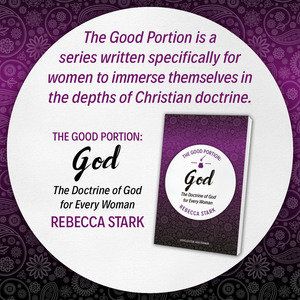
The Good Portion: God explores what Scripture teaches about God in hopes that readers will see his perfection, worth, magnificence, and beauty as they study his triune nature, infinite attributes, and wondrous works.



 Wednesday, June 11, 2025 at 3:30AM
  The Darkness at the Crucifixion by Gustave Doré
I have two sixty-year-old dressers that I will never need to replace because they were built to last, something I can’t say for the newer ones I’ve owned. I have a more recently manufactured one with so many broken drawers that as soon as shelves are built for the fabric I’ve stored in it, I’ll to haul it to the dump.
But older isn’t always better than new, is it? I wouldn’t want to go back to a flip phone, let alone the phone I used as a child when my whole family shared a single rotary phone mounted on the wall of our kitchen. Most of my childhood friends had home phones that were connected to a party line, which meant they shared a single phone line with several of their neighbours. If one neighbor was making a call, no one else could make or receive calls. And there was no such thing as a truly private telephone conversation, because all the members on a party line could listen in on each others’ calls. Thankfully, phone technology has come a long way since then. In the world of telephones, newer is definitely better.
Over the past couple of years, we’ve made our way through Hebrews 11, examining each of the Old Testament men and women included in the hall of faith. We can learn much about faithfulness from these ancient saints, but no informed believer living now would want to travel back to their time. When it comes to the way God relates to his people, we have it better than they did. They were all
commended for their faith, yet none of them received what had been promised, since God had planned something better for us so that only together with us would they be made perfect (Hebrews 11:39–40 NIV).
God promised these Old Testament believers that there would be better days to come, but none of them lived to see it. Now, in our age—in the time period after Jesus died and rose again—this promise has been fulfilled. We have what they hoped for.
Of course, God fulfilled some of his promises to the people in the hall of faith during their lifetimes. He preserved Noah and his family in the flood (verse 7), for instance, and gave Abraham and Sarah a son (verses 11-12). He delivered the whole nation of Israel from the Egyptians (verses 28-29). But none of them—from Abel, the son of the first man Adam, to the Jewish martyrs who lived in the era between the Old and New Testaments—received the fulfillment God’s biggest promise.
But we have. This is the theme of the entire epistle of Hebrews: Jesus has come and everything is better; God’s big promise has now been fulfilled. For every believer alive during the New Testament era, the patterns and shadows of the Old Testament have become solid reality.
A Better Covenant
The people included the hall of faith lived under the Mosaic (or Old) Covenant, an agreement planned and instituted by God for the benefit of his people. It bound them to him and defined his relationship to them. But the Old Covenant wasn’t built to last. It was always meant to be a precursor to a new, better, and everlasting covenant God intended to establish in the future.
Mosaic Covenant laws gave God’s people a standard for righteous living and convicted them of sin when they failed to live up to that standard. The Old Covenant sacrificial system provided a way for God to overlook those sins so he could dwell with them. But he could only be with them if he was masked by a cloud or smoke, or concealed behind the curtain in the temple or tabernacle. No one could be in God’s unveiled presence and live because Old Covenant laws couldn’t transform people’s inner lives (Hebrews 8:10-11), and its priests and sacrifices couldn’t actually cleanse their consciences (Hebrews 9:9) or provide final forgiveness for them (Hebrews 8:12, 9:15, 10:11). The Old Covenant, then, couldn’t offer anyone unmediated access to God (Hebrews 9:7-8).
But the New Covenant—the one long-promised by God and instituted by Jesus—can accomplish all these things because it has a better priesthood and a better sacrifice (Hebrews 8:6). In the New Covenant, all the blessings the Mosaic Covenant could only foreshadow have come, and all the promises God made to the Old Testament faithful have been fulfilled (2 Corinthians 1:20). And the Old Covenant, like the dial phone of my youth, has become obsolete (Hebrews 8:13).
A Greater High Priest and a Perfect Sacrifice
Under the Old Covenant, the high priest offered animal sacrifices to God, but animals cannot actually take away human sin (Hebrews 10:4). What’s more, because he was a sinner, the high priest needed to offer a sacrifice for his own sin before he could offer one for the people. But Jesus, who is the New Covenant high priest, offered himself, a true human to effectively atone for human sin. And there was no need for him to offer a sacrifice for his own sin first because he was sinless (Hebrews 7:27).
That the Old Covenant priests kept offering sacrifices year after year shows us their sacrifices were ineffective (Hebrews 10:1-4). But Jesus’s one sacrifice of himself never needs to be repeated because it removed sin once for all time (Hebrews 10:10-14). Every Old Covenant high priest died eventually and needed to be replaced, but Jesus’s priesthood is permanent because he is eternal. “[H]e is able to save completely … because he always lives to intercede for [his people]” (Hebrews 7:23-25).
An Old Covenant priest was only allowed into the Most Holy place in the tabernacle once a year, and there was always a risk he might die if he didn’t carefully follow God’s instructions (Leviticus 16:2, 13). But Jesus’s perfect sacrifice of himself opened the way for all those who are united to him to come right into God’s presence where they are sure to receive mercy and grace rather than judgment (Hebrews 4:16). In Jesus, any believer can approach God in the heavenly Holy Place (Hebrews 10:19-22) with more confidence than an Old Covenant priest could approach him in the earthly Holy Place.
People Made Perfect
This free and open access to God that we have now is what the author of Hebrews has in mind, I think, when he writes in verse 11:40 (quoted above) about believers being made perfect (see 10:14, too). It’s not that we are sinless—yet!—but under the New Covenant, with Jesus as both our high priest and sacrifice, our sins have been forgiven. Sin no longer stands between God and us, so we can enter his presence boldly.
And in Jesus, Old Testament believers have full forgiveness, too. They have, as 11:40 also says, been made perfect together with us. In the Old Covenant era, God left their sins unpunished, but they weren’t actually forgiven until Jesus, the New Covenant High Priest, offered himself as an atoning sacrifice (Romans 3:25-26). Now, as “spirits of the righteous made perfect,” they, too, have unhindered access to God. As I write this, and as you read, they are with him in the heavenly Jerusalem (Hebrews 12:23) anticipating the time when we will all—Old and New Covenant believers together—receive our glorified bodies. They are waiting to live with us forever in the new heavens and the new earth, which will be ultimate, everlasting perfection for us all.
I bet those men and women in the Hebrews hall of faith rejoiced when the days of the New Covenant finally came and they received true forgiveness in Jesus! What do you think they would have said to a first century Christian who was toying with the idea of returning to the Old Covenant religious system? What would they say to any New Covenant believer—first century or twenty-first—who is tempted to walk away from Jesus because they question whether remaining true to him through the trials that accompany a life of faith will be worth it in the end?
I think they would probably say the same thing the author of Hebrews does: Be inspired by our faithfulness. Keep on believing God’s promises like we did. But more than anything, keep your eyes on Jesus. He instituted a new and better covenant, sacrificed himself to accomplish complete forgiveness, and opened the way to the throne of grace. There is no other way to God than through faith in him, and no better reward for perseverance in faith than eternity with him. He endured the pain of his sacrifice because he was looking forward to his exaltation at the right hand of God (Hebrews 12:1-3). Be like Jesus and stay true to the end so you can one day join him and all the faithful Old Covenant believers in the city of the living God (Hebrews 12:15-24).
Previous post in this series: